
India-Republic of Korea Strategic Vision 2026–2030:
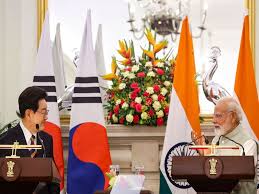
India and the Republic of Korea (ROK) have unveiled a Joint Strategic Vision for 2026–2030 during the state visit of South Korean President Lee Jae Myung to India.
- The vision outlines an ambitious roadmap to deepen the India–ROK Special Strategic Partnership across political, economic, technological, and cultural domains.
- The India–Republic of Korea (ROK) Joint Strategic Vision (2026–2030) marks a shift from economic ties to a comprehensive strategic partnership spanning Indo-Pacific security, emerging technologies, defence, and climate cooperation.
- Its success depends on addressing trade imbalances, deepening defence and tech collaboration, and aligning geopolitical priorities to fully realise the partnership’s potential.
Key Highlights of the India-Republic of Korea (ROK) Joint Strategic Vision (2026-2030):
- Strengthening Political and Institutional Engagement: India and the ROK agreed to reinforce ties through annual leader-level meetings, expanded ministerial dialogues, and the launch of an India–ROK Industrial Cooperation Committee as a new mechanism for industry-level engagement, while promoting parliamentary exchanges, youth interactions, and deeper state-to-province partnerships.
- India and the ROK agreed to deepen strategic coordination by building on the Foreign Policy and Security Dialogue and operationalising cooperation through the Defence Industry Joint Committee and the inaugural 2+2 Dialogue at the Vice Minister level.
- Act East meets New Southern Policy: The Vision officially synchronizes India’s “Act East Policy” with South Korea’s “New Southern Policy,” transitioning the relationship from purely economic ties to a broader Indo-Pacific security partnership.
- India and the ROK reaffirmed their shared vision of a free, open, and rules-based Indo-Pacific, and welcomed the ROK’s participation in India-led Indo-Pacific Oceans Initiative (IPOI).
- The India–ROK Economic Security Dialogue aims to de-risk supply chains by reducing dependence on China and promoting diversification of critical resources and technologies.
- The Vision explicitly outlines a roadmap for joint defense R&D, focusing on co-production under the Atmanirbhar Bharat initiative, moving past the bureaucratic hurdles that stalled previous naval deals (like the minesweepers project).
- They welcomed the opening of the office of Korea Marine Equipment Association (KOMEA) in Mumbai, the first such office that will contribute to the development of ancillary ecosystem to support the maritime industry.
- The India-Korea Digital Bridge is a new initiative targeting critical and emerging technologies (CET).
- It establishes joint task forces focused on Artificial Intelligence (AI), data governance, and semiconductor design and fabrication guided by the principles of “AI for All” and “MANAV”.
- A landmark Memorandum of Understanding (MoU) was signed integrating India’s National Payment Corporation of India Limited (NPCIL) with Korea’s KFTC (Korea Financial Telecommunications and Clearings Corporation).
- This allows for seamless, real-time cross-border payments, bypassing traditional Western financial clearing houses.
- India and the ROK agreed to enhance space cooperation by establishing an Indian Space Research Organisation (ISRO) – Korea Aerospace Administration (KASA) Joint Working Group and promoting collaboration through initiatives like the India–ROK Space Day held in Bengaluru on 20th April 2026.
- A Joint Declaration was issued to formally restart and expedite the stalled upgrade of the Comprehensive Economic Partnership Agreement (CEPA).
The outcome document specifically acknowledges the need to address the “trade asymmetry” and dismantle Non-Tariff Barriers (NTBs) hindering Indian exports. - ROK welcomed India’s participation in the Pax Silica initiative, while India appreciated ROK’s leadership in Forum on Resource Geostrategic Engagement (FORGE).
- The FORGE is a United States-led multinational initiative launched in February 2026 to secure and diversify global supply chains for critical minerals.
- India is a supporter and participant of FORGE.
- Both agreed to enhance cooperation on securing critical materials like naphtha during supply disruptions and expand bilateral trade in such resources.
- The two nations established a framework under Article 6.2 of the Paris Agreement to cooperate on carbon credit trading and joint emissions reduction projects.
- South Korea officially joined the India-headquartered International Solar Alliance (ISA), while India reciprocated by formally joining the Seoul-headquartered Global Green Growth Institute (GGGI), cementing a two-way institutional climate partnership.
- India and the ROK agreed to enhance cooperation in multilateral forums such as the G20, especially in light of the ROK’s upcoming presidency in 2028.
- Reaffirmed commitment to resolving disputes peacefully in accordance with international law, including UNCLOS.
- India and the ROK agreed to deepen cultural cooperation by extending the Cultural Exchange Programme (2026–2030), declaring 2028–29 as the Year of Friendship.



