
Pellet Guns and Shock Batons:
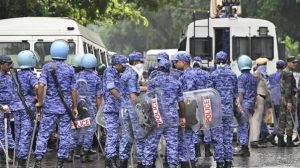
Pellet guns are back in the spotlight following allegations of their use during the July 2026 Delhi youth and student protest organised by the Cockroach Janta Party (CJP).
- Categorized globally as “non-lethal” crowd-control methods (alongside tear gas and water cannons), pellet guns fire cartridges containing hundreds of lead pellets.
- While designed to immobilize, they can cause fatal injuries or permanent blindness if fired at close range into soft tissues or eyes.
- The ammunition is manufactured at the Ordnance Factory, Ishapore. Standard Operating Procedures (SOPs) mandate that security personnel open minimal fire and aim strictly “below the waist”.
- First deployed by the Government during the 2010 Kashmir summer unrest, pellet guns drew international scrutiny following the 2016 Kashmir unrest, where CRPF deployment resulted in mass blinding injuries.
- This led to the 2017 introduction of alternative “plastic bullets,” tested at the Terminal Ballistics Research Laboratory (TBRL) in Chandigarh.
- A shock baton is a handheld electroshock device used by security forces as a non-lethal self-defence and crowd-control weapon. It incapacitates a person by delivering a high-voltage, low-current electric shock, causing temporary pain and muscle disruption without intended long-term injury.
- In India, Rapid Action Force (RAF) personnel carry shock batons as part of their standard crowd-control equipment.
- In 2021, the Ministry of Home Affairs (MHA), through the Border Security Force (BSF), prescribed Qualitative Requirements (QRs) for handheld shock batons, including a maximum weight of 1 kg, length of 450–700 mm, operating temperature of −20°C to +50°C, minimum service life of five years, and a rechargeable battery capable of delivering at least 1,000 quarter-second shock bursts on a full charge.
- They are also designed with high-impact-resistant and water-resistant materials for field operations.



