
Sjogren’s Disease:
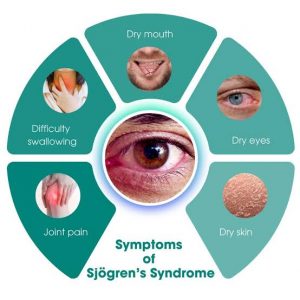
Researchers from Japan recently discovered a self-reinforcing loop between different immune cells that sustains autoimmune responses in patients with Sjögren’s disease.
- Sjogren’s disease (also called Sjögren’s syndrome) is a chronic autoimmune disorder where the immune system mistakenly attacks its own moisture-producing glands.
- It typically attacks the glands that produce tears, saliva, and sweat. Other parts of the body may also be affected.
- The exact cause of Sjogren’s syndrome is unknown, though there seems to be a genetic influence.
- It is thought that factors such as viral infections, stress, and hormone changes can trigger symptoms of Sjogren’s syndrome.
- Sjogren syndrome can happen at any age. But most people are older than 40 at the time of diagnosis.
- Ninety percent (90%) of adults diagnosed with Sjogren’s are women.
- Sjogren’s can occur alone or in association with other autoimmune diseases, most commonly lupus and rheumatoid arthritis (RA).
- Symptoms: People with Sjogren’s syndrome can have:
- dry eyes, which may also feel painful, burning, itchy, or gritty
- a dry mouth, making it difficult to swallow, speak, or eat dry foods
- swelling of the glands in the face and neck areas
- Some people with Sjögren’s syndrome also notice:
- joint pain, swelling and stiffness
- dry skin or skin rash
- vaginal dryness
- persistent dry cough
- ongoing fatigue
- Sometimes the liver and kidneys are affected. A few people will also develop lymphoma (cancer of the lymph nodes).
- There is no cure for Sjögren’s syndrome.
- Treatment for Sjogren’s disease attempts to relieve the effects of chronic dryness of the mouth and eyes by increasing the lubrication and moisturization of the affected tissues.



