
Svalbard:
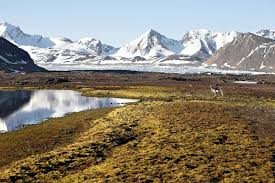
A significant new discovery recently emerged in the Arctic, with scientists spotting an unexpected gathering of walruses on the remote shores of Svalbard, a wild stretch of land nestled between mainland Norway and the North Pole.
- Svalbard is a Norwegian archipelago that is situated in the Arctic Ocean, to the north of the European mainland.
- It is located about halfway between the North Pole and the northern part of Norway.
- It is the northernmost place in the world with a permanent population.
- It was discovered by the Dutch explorer Willem Barentsz in 1596.
- The Svalbard Treaty, 1920 established Norwegian sovereignty over the Svalbard Islands.
- Spitsbergen is the largest and most populous
- The island is bounded by the Arctic Ocean, the Greenland Sea, and the Norwegian Sea.
- The Svalbard Global Seed Vault is also located on Spitsbergen. It is the largest backup facility for the world’s crop diversity.
- The archipelago features an Arctic climate, although with significantly higher temperatures than other areas at the same latitude.
- Due to its location in the northern part of the Arctic Circle, the Svalbard Islands experience the midnight sun during the summer months and polar night during the winter months.
- Vegetation consists mostly of lichens and mosses; the only trees are the tiny polar willow and the dwarf birch.
- Svalbard is a breeding ground for many seabirds, and also features polar bears, reindeer, the arctic fox, and certain marine mammals.
- Walrus is a large mammal that lives in the cold Arctic seas of Europe, Asia, and North America.
- It is closely related to the seals.
- The walrus can be told apart from seals by the two large upper teeth, called tusks, that stick down from its mouth.
- Scientific Name: Odobenus rosmarus.
- There are two subspecies: the Atlantic walrus (Odobenus rosmarus rosmarus) and the Pacific walrus (O. rosmarus divergens).