
What is a Mud Volcano?
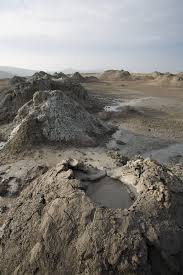
A mud volcano suddenly erupted in Diglipur, Andaman Islands, recently.
- It is a mound of mud heaved up through overlying sediments.
- The craters are usually shallow and may intermittently erupt mud.
- These eruptions continuously rebuild the cones, which are eroded relatively easily.
- Some mud volcanoes are created by hot-spring activity where large amounts of gas and small amounts of water react chemically with the surrounding rocks and form a boiling mud.
- Other mud volcanoes, entirely of a nonigneous origin, occur only in oil-field regions that are relatively young and have soft, unconsolidated formations.
- Mud volcanoes, also known as “sedimentary volcanoes” or “gas-oil volcanoes,”.
- Mud volcanoes also exist on the floor of the sea and can form islands and banks that alter the topography and shape of the coastline.
- In India, the only mud volcano lies in Baratang Island, a part of the Andaman chain of islands.