
Today’s Current Affairs: 13th April 2026 for UPSC IAS exams, State PSC exams, SSC CGL, State SSC, RRB, Railways, Banking Exam & IBPS, etc
Table of Contents
Quantum Cloning:

Researchers have experimentally demonstrated a method to create perfect copies of quantum states by exploiting a loophole in the fundamental no-cloning theorem, opening transformative possibilities for quantum computing and cloud storage infrastructure.
- No-Cloning Theorem: It is a foundational rule in quantum physics that prohibits the perfect duplication of unknown quantum states — it has been central to quantum cryptography and quantum computing since their inception.
- Unlike classical computing (where copying files is trivial), quantum computers cannot duplicate data freely, making the no-cloning theorem a major barrier to building robust quantum systems.
- Quantum information is destroyed upon measurement, making conventional copying impossible. This theorem has been the cornerstone of quantum cryptography and quantum computing since their inception.
- Loophole: Researchers established that perfect quantum copies can be created, provided each clone is individually encrypted using quantum noise, rendering it inaccessible without a corresponding decryption key.
- Without the key, the copy appears as meaningless random data to anyone, including an attacker.
- This encryption is performed using special ‘noise qubits’ that store the locking pattern and serve as the decryption key.
- The original quantum information is spread across multiple qubits, each looking like random noise individually, ensuring the data remains naturally secure.
- One-Time Use Rule: Once the decryption key is used to recover one perfect copy, the key is permanently destroyed.
- All remaining copies become irreversibly unreadable. This means only one perfect recovery is ever possible, which is consistent with the spirit of the no-cloning theorem, just interpreted differently.
- Strategic Applications: This breakthrough has profound implications for the development of redundant quantum cloud storage and reliable quantum memories, allowing clients to recover perfect data as long as at least one server survives.
The Viksit Bharat Shiksha Adhishthan Bill, 2025:
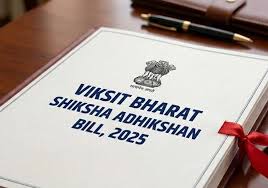
The Viksit Bharat Shiksha Adhishthan (VBSA) Bill, 2025, introduced in the Lok Sabha, seeks to revolutionize higher education by establishing a single apex regulatory body.
Viksit Bharat Shiksha Adhishthan Bill, 2025:
- The Bill proposes the creation of the Viksit Bharat Shiksha Adhishthan (the Commission) as the supreme regulatory authority for higher education in India.
- It aims to implement the National Education Policy (NEP 2020) by replacing three major existing regulators: the University Grants Commission (UGC), the All India Council for Technical Education (AICTE), and the National Council for Teacher Education (NCTE).
Key Features of the Bill:
- Three Verticals: The Commission will operate through three specialized Councils:
- Regulatory Council: Acts as a common regulator for institutional governance.
- Accreditation Council: Oversees the quality assessment and accreditation systems.
- Standards Council: Determines academic standards and learning outcomes.
- Purview and Exemptions: The Bill covers all Higher Educational Institutions (HEIs) except for legal and medical education, which remain under separate Acts.
- Separation of Funding: In a major shift, the Commission and its Councils will have no power to allocate grants; funding authority is moved directly to the Ministry.
- Composition: The Commission features a Chairperson (honorary) and 12 members, while each Council has a President and up to 14 members, primarily eminent experts and government nominees.
- Penalties: The Regulatory Council can impose fines between ₹10 lakh and ₹70 lakh for violations and can even order the closure of an HEI.
- Adjudicatory Mechanism: Appeals against the Commission’s decisions lie directly with the Central Government.
FIU-IND and I4C MoU on Financial Crimes:
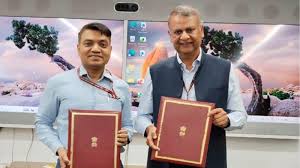
The Financial Intelligence Unit-India (FIU-IND) and the Indian Cyber Crime Coordination Centre (I4C) have signed a Memorandum of Understanding (MoU) to establish a coordinated framework for intelligence sharing, aimed at securing India’s digital payment ecosystem and combating cyber-enabled financial crimes.
- The partnership adopts a “Whole of Government” approach to enhance fraud detection protocols, prevent financial crimes, and facilitate asset recovery.
- The MoU enables the development of red flag indicators and guidelines for financial institutions to proactively identify suspect financial transactions.
- The collaboration aims to mitigate the misuse of telecom and banking resources, ensuring robust guardrails for India’s rapidly transforming digital economy.
- FIU-IND is the central national agency responsible for receiving, processing, analysing, and disseminating information relating to suspect financial transactions and coordinating efforts against money laundering and financing of terrorism.
I4C - It is an attached office of the Ministry of Home Affairs (MHA) that provides a comprehensive ecosystem for Law Enforcement Agencies (LEAs) to tackle cybercrime.
- I4C has developed various platforms such as National Cybercrime Reporting Portal (NCRP), Cyber-Police, Suspect Registry, etc., which are secure platforms for real-time intelligence sharing and coordination among various stakeholders, including LEAs, Banks and Financial Institutions.
- These platforms help combat cybercrimes, including online financial crimes, by enabling proactive action against the misuse of telecom, banking and other related resources.
Export Inspection Council:
India said that the requirement for a certificate of inspection from Export Inspection Council (EIC) for rice exports is limited to the EU, UK, Iceland, Liechtenstein, Norway and Switzerland.
- It was set up by the Government of India under Section 3 of the Export (Quality Control and Inspection) Act, 1963.
- It ensures sound development of export trade of India through quality control and inspection and matters connected therewith.
- It is the official export –certification body of India which ensures quality and safety of products exported from India.
- It is headed by a Chairman.
- The Executive Head of the Council is the Director of Inspection & Quality Control who is responsible for day to day functioning of the Council.
- It ensures that products notified under the Export (Quality Control and Inspection) Act 1963 are meeting the requirements of the importing countries in respect of their quality and safety.
- It provides mandatory certification for various Food items namely fish & fishery products, dairy products, honey, egg products, meat and meat products, poultry meat products, animal casing, Gelatine, Ossein and crushed bones.
- The Export Inspection Agencies (EIAs) are located at Mumbai, Kolkata, Kochi, Delhi and Chennai with a network of 30 sub offices backed by the state of art, NABL accredited laboratories at various places.
- Headquarter: Delhi
- Nodal Ministry: Ministry of Commerce and Industry.
Trends in India’s Female Credit Market:
The joint report by NITI Aayog, TransUnion CIBIL, and MicroSave Consulting (MSC), titled “From Borrowers to Builders: Women and India’s evolving credit market,” highlights women are transitioning from basic financial access to becoming key drivers of the entrepreneurial economy.
Key Highlights of the Report:
- Significant Portfolio Growth: Women borrowers now hold a credit portfolio of Rs 76 lakh crore, accounting for 26% of total system credit—a nearly 5-fold increase since 2017.
- Rapid Expansion in Business Lending: While retail loans still dominate, the business-purpose loan segment for women has surged 7.5x since 2017, now making up 25% of their total credit value.
- Improved Credit Penetration: The percentage of credit-active women has doubled, rising from 19% in 2017 to 36% in 2025, representing approximately 16 crore active women borrowers.
- The Impact of Digitization: Digital infrastructure (DPI) like UPI and Aadhaar e-KYC has dramatically reduced friction; for example, same-day approvals for consumption loans rose from 34% in 2022 to 45% in 2025.
- Shift Toward Sophistication: Women entrepreneurs are increasingly graduating from entry-level microfinance to more complex products like cash credit and overdraft facilities, signalling increased enterprise maturity.
- Regional Growth Trends: While South and West India anchor the highest volumes, North Indian states like Bihar and Uttar Pradesh are emerging as high-growth markets, recording business loan Compound Annual Growth Rate (CAGRs) of 59% and 42%, respectively.
- Rural Women Nano-Entrepreneurs (RWNEs): The report emphasizes that digital adoption is widespread (60–70% use digital payments), but independent and strategic usage is often limited by “time poverty” and shared device constraints.
- Superior Credit Behavior: Data indicates women borrowers are more reliable, defaulting 30% less than (0.7x default rates) the general market average as of 2024.
Sulphur:
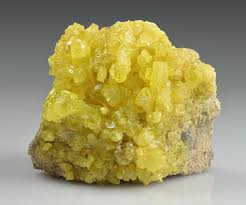
The West Asia conflict disrupts supply chains, deeper shocks emerge and Sulphur may not grab headlines like oil, but it quietly powers industry and agriculture.
- Sulphur (identified by the letter S) is a non-metallic chemical element.
- It can be found as a pure element or as sulphate or sulphide minerals.
- It occurs naturally in the environment and is believed to be the thirteenth most abundant element in the earth’s crust.
- In its pure form, sulphur is a tasteless, odorless, brittle solid with a pale yellow color.
- It’s a poor conductor of electricity that doesn’t dissolve in water.
- It combines directly with almost all the elements with the exception of gold, platinum and the noble gases.
- Distribution of Sulphur in India: Puga Valley, Barren Island of Bay of Bengal, Andhra Pradesh, Kerala and Himachal Pradesh
- Sulphur is an essential raw material for many chemical industries and is essentially used for the production of sulphuric acid.
- Sulphuric acid is a strong mineral acid which is used in ore processing, fertilizer manufacturing, oil refining, waste water processing and chemical synthesis.
- Powdered form of sulphur produced by sublimation process is generally used in rubber vulcanisation, agricultural dusts, pharmaceutical products and stock feeds.
- Sulphur is used as a light-generating medium in the rare lighting fixtures known as “sulphur lamps”.
- Sulphur compounds are also used in detergents, fungicides, dyestuffs and agrichemicals.
Lanjia Saora Tribe:

It is observed that among the younger members of the Lanjia Saora Tribe community, tradition is being reinterpreted and negotiating modernity on its own terms.
- Saora is one of the ancient tribes of Odisha and categorized as a particularly vulnerable tribal group.
- Other names: Savaras, Sabaras, Saura, Sora, etc.
- A small number of people are also found in the states of Andhra Pradesh, Jharkhand, Madhya Pradesh, and Assam.
- They have their own native language called Sora, which is a Munda language, and they are one of the very few tribes of India that have a script for the language, Sorang Sompeng.
- They show their racial affinity to the Proto Australoid physical characters.
- They are living in mud-and-thatch homes scattered across undulating terrain,
- The community sustains itself through shifting cultivation, foraging, and small-scale farming.
- Saoras follow an ingrained and intricate religion, having faith in and worshipping a number of gods and spirits, who they believe are the supreme controllers of their regular lives.
- They have unique art practices, religious customs, as well as a dying tattooing tradition called ‘Tantangbo’.
- Their belief system is closely tied to nature, with rituals, music, and dance forming an integral part of everyday life.
- Among the most distinctive visual traditions are their large metal earrings — thick, circular ornaments that are not merely worn but fixed into stretched earlobes, often over years.
- Village guardian deities like Kitungsum are installed at the entrance of the settlement.
Indus River Dolphin:
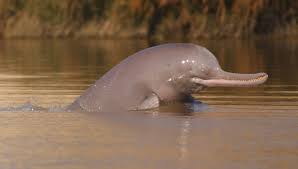
It was observed that conservation reserves, citizen science, and habitat protection gives the Indus River dolphin a fighting chance in India.
- The Indus River dolphin (Platanista minor) is one of the rarest mammals.
- It has the long, pointed nose characteristic of all river dolphins.
- The teeth are visible in both the upper and lower jaws even when the mouth is closed.
- It presently only occurs in the Indus River system, along with a remnant population in the Beas River.
- Features of Indus River Dolphin:
- It is functionally blind.
- It has extremely reduced eyes without lenses.
- Instead of vision, it relies entirely on echolocation to navigate, hunt and avoid obstacles in the highly turbid waters.
- It has a remarkable trait of swimming predominantly on its side.
- This allows it to use its long, sensitive snout to probe the riverbed for prey. Side-swimming is extremely rare among cetaceans and is a signature feature of this species.
- It lives largely solitary or in very small groups (typically mother-calf pairs).
- These are carnivores (piscivores). They feed on a variety of fish and crustaceans, including prawns, carp, catfish, and gobies.
- Threats: Water pollution, poaching, fragmentation of habitat due to barrages
- Conservation Status:
- IUCN Red List: Endangered
- Wildlife Protection Act 1972: Schedule I
India ranked 3rd globally in RE capacity:
India has climbed to the 3rd position globally in renewable energy (RE) installed capacity, surpassing Brazil, according to the Union Ministry of New and Renewable Energy.India has become the world’s third-largest country in installed renewable energy capacity, reflecting its rapid progress in the transition toward a low-carbon and sustainable energy system.
Key Data / Stats:
- Global Rank: 3rd (after China and United States)
- India has emerged as the third-largest country in the world in renewable energy installed capacity, reflecting rapid progress in green infrastructure.
- Total non-fossil installed capacity: 283.5 GW
- This represents the combined installed capacity from solar, wind, hydro, nuclear, and other non-fossil sources, strengthening India’s clean energy mix.
- Capacity added in 2025–26: 55.3 GW
- India recorded its highest-ever annual addition of non-fossil power capacity, indicating accelerated expansion of renewable infrastructure.
- Rooftop solar contribution: 8.7 GW
- A major share of the growth came from decentralized household and commercial rooftop solar systems, improving distributed energy access.
- Peak RE share in electricity generation: 51.5%
- At its peak, renewable sources supplied more than half of India’s total electricity demand, marking a major clean energy
Womaniya: Building Inclusive Market Access for Women Entrepreneurs
The Womaniya initiative on the Government e-Marketplace (GeM) was highlighted, for its success in enabling over 2.1 lakh women entrepreneurs to secure orders worth ₹28,000 crore.Launched in 2019 under the Ministry of Commerce & Industry, Womaniya is an inclusion-focused initiative on the GeM platform. It provides a dedicated digital interface for women-led micro and small enterprises (MSEs) and SHGs to list products like handicrafts, handloom, and office accessories for direct purchase by Central and State Ministries and PSUs.
Key Data and Statistics:
Registration Growth: Over 2.1 lakh women MSEs are currently registered on the GeM platform.
Order Volume: Women entrepreneurs secured 13.7 lakh orders in the 2025-26 financial year.
Contract Value: Total contract value awarded to women MSEs reached over ₹28,000 crore, a growth of 27.60% over the previous year.
Target Surpassing: While the mandated procurement target is 3%, women-led orders accounted for 5.6% of GeM’s total orders.
Keytruda:
Recent investigations have exposed a dangerous counterfeit market for Keytruda in India, where hospital-level breaches and high drug prices have led to fakes being sold to desperate patients.Keytruda is the brand name for Pembrolizumab, a revolutionary immunotherapy drug used to treat various advanced and aggressive cancers.Unlike traditional treatments that attack the tumor directly, Keytruda is a checkpoint inhibitor that helps the body’s own immune system identify and destroy cancer cells.It is manufactured by the U.S.-based global pharmaceutical giant Merck & Co. (known as MSD outside the U.S. and Canada).The primary goal of Keytruda is to remove the brakes on the immune system. Specifically, it seeks to prevent cancer cells from hiding from the body’s T-cells, thereby allowing the immune system to launch an effective attack against the tumor.



