
Today’s Current Affairs: 27th May 2026 for UPSC IAS exams, State PSC exams, SSC CGL, State SSC, RRB, Railways, Banking Exam & IBPS, etc
Table of Contents
Babesia Infection:
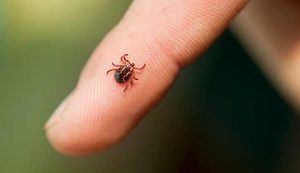
Two lion cubs recently died in Gujarat’s Gir National Park region due to a suspected Babesia infection.
- Babesia is a genus of microscopic parasites that infect the red blood cells (RBCs) of animals and humans, causing the disease known as babesiosis.
- These protozoa are transmitted mainly by the bite of ticks, primarily by the Ixodes tick, also known as a deer tick, which is also responsible for transmitting other diseases, such as Lyme disease.
- Babesiosis can affect both animals and humans, although it is much more common in animals, especially cattle, dogs, and other mammals.
- Human infection is more common in areas where ticks are common.
- The geographical distribution of Babesia is primarily in the Americas, especially in the Northeast region, as well as regions of Europe and Asia.
Babesiosis isn’t contagious from person to person. - Rarely, Babesia is transmitted from a pregnant women to the fetus.
- Treatment for babesiosis usually involves a combination of antimicrobial drugs, as the infection is caused by a parasite.
- The most recommended is a combination therapy of two drugs, atovaquone (antiparasitic) and azithromycin (antibiotic).
Mekedatu Project: In News
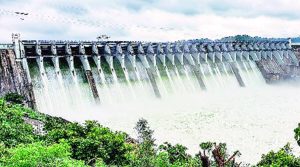
The Supreme Court recently dismissed a petition filed by Tamil Nadu to review a November 2025 decision that termed the State’s challenge to Karnataka’s proposed Mekedatu Balancing Reservoir cum Drinking Water project as “premature”.
- Mekedatu Project is a multi-purpose (drinking water and power) project involving the construction of a balancing reservoir near Kanakapura in the Ramanagara district, Karnataka.
- The project is proposed at the confluence of the Cauvery River with its tributary Arkavathi.
- It will have a capacity to store 67 tmcft of water, supplying drinking water to Bengaluru and generating 400 MW of power.
- Tamil Nadu, the lower riparian state, has been opposing the project, raising apprehensions that the state would be affected if the project takes shape.
- Tamil Nadu says, Mekedatu area represents the last free point in Karnataka from where Cauvery water flows unrestricted into Tamil Nadu, and the Mekedatu dam project is an attempt by Karnataka to block this free flow of water.
Justice (Retd) Prakash Prabhakar Naolekar Committee:

The Centre recently constituted a high-level committee under Justice (Retd) Prakash Prabhakar Naolekar to assess demographic changes across India due to “illegal immigration and other unnatural causes”.
- It is a high-level committee constituted to assess demographic changes across India due to “illegal immigration and other unnatural causes”.
- The five-member committee will be chaired by retired Justice Prakash Prabhakar Naolekar.
- It will also include the Census Commissioner along with Durga Shankar Mishra (Retd. IAS), Balaji Srivastava (Retd. IPS), and Dr. Shamika Ravi as members.
- The Joint Secretary (Foreigners-I), Ministry of Home Affairs, will serve as the committee’s Member Secretary.
- The committee has been tasked with studying patterns of demographic change across the country, identifying their causes, and suggesting legal, administrative, and policy measures to address the issue.
- The panel is expected to submit its report within a year.
INS Kolkata:
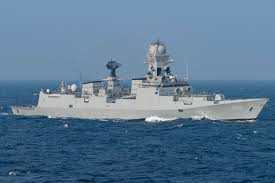
INS Kolkata successfully responded to a suspected piracy threat involving merchant vessel MV Mashallah 1 in the Western Indian Ocean recently, preventing a possible hijacking attempt amid rising maritime security concerns in the region.
- It is the lead ship of the indigenously designed and constructed Kolkata-class guided missile destroyers of the Indian Navy.
- The Project 15A Kolkata-class destroyers are follow-ons of the legendary Project 15 ‘Delhi’-class destroyers which entered service in the late 1990s.
- Conceived and designed by the Indian Navy’s Directorate of Naval Design, the ships have been christened after major port cities of India, viz. Kolkata, Kochi, and Chennai.
- INS Kolkata was built by Mazagon Dock Limited, Mumbai.
- It was commissioned in 2014.
- The ship has a Combined Gas and Gas (COGAG) propulsion system, consisting of four powerful reversible gas turbines, and can attain speeds in excess of 30 knots.
- The ship’s electric power is provided by four gas turbine generators and one diesel alternator, which together produce 4.5 Mega-Watts of electrical power, enough to light up a small town.
- It is equipped with an array of gunnery and Anti-Submarine Warfare (ASW) weapons, medium-range and short-range guns, anti-air and surface missiles, air and surface surveillance radar, and bow-mounted sonar.
- The ship can be truly classified as a ‘Network of Networks’ as it is equipped with sophisticated digital networks, such as ATM-based Integrated Ship Data Network (AISDN), Auxiliary Control System (ACS), Automatic Power Management System (APMS), and Combat Management System (CMS).
- The ship is capable of operating two Seaking or Chetak helicopters.
Interfilum shuklaii:
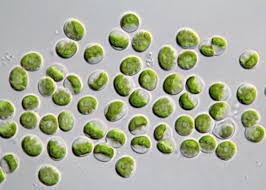
A group of researchers at Catholicate College has discovered a new species of green algae named Interfilum shuklaii from the Western Ghats in Kerala.
- Interfilum shuklaii is a new species of green algae.
- It was discovered in the forests of Kerala’s Western Ghats.
- It is named after Group Captain Shubhanshu Shukla, a test pilot and astronaut with the Indian Air Force.
- It belongs to the family Klebsormidiaceae, under the order Klebsormidiales.
- It is distinguished by features such as a non-striated mucilage envelope and mother cell wall remnants forming a dome-shaped cap.
- It is the first-ever reported discovery of the genus Interfilum from India.
- Interfilum has emerging significance in biotechnology, carbon sequestration, biofertilizer development, and future space life-support systems due to its stress tolerance and efficient biomass production.
Vaccinium Piliferum:
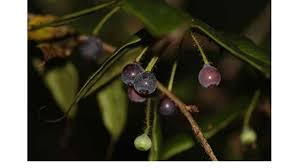
Researchers have rediscovered ‘Vaccinium piliferum’ in the remote forests of Vijoynagar in Arunachal Pradesh’s Changlang district nearly after 188 years.
- Vaccinium Piliferum is a rare and endangered wild relative of blueberry species.
- It belongs to the Ericaceae family, which includes blueberries and cranberries.
- It was rediscovered in the Eastern Himalayan region.
- The plant was originally recorded in 1836 during the colonial period.
- The species was found near tributaries of the Noa-Dihing River in the dense forests
- The International Union for Conservation of Nature has listed ‘Vaccinium piliferum’ as an ‘endangered’ species.
- Blueberries are a member of the Ericaceae or heath family.
- Types of blueberries: Lowbush (Vaccinium angustifolium), Highbush (Vaccinium corymbosum L.) and bilberry or forest blueberry (Vaccinium myrtillus) etc.
- Climate and soil: Blueberry requires relatively cold climate with 150 to 1200 hours of chill units to break dormancy.
- It prefers well-drained, acidic, sandy loam soils with organic matter content greater than 3%.
- Too cold temperature is detrimental and kills blueberry shoots and flower buds.
- They are packed with essential nutrients, including vitamin C, vitamin K, and dietary fiber. They also contain powerful antioxidants that help combat free radicals in the body.
Khadi and Village Industries Commission:
The Khadi and Village Industries Commission (KVIC) has achieved a historic milestone in the financial year 2025-26, recording sales of one lakh 87 thousand crore rupees.
- Khadi and Village Industries Commission is a statutory body established under the Khadi and Village Industries Commission Act of 1956.
- It is an apex organization under the Ministry of Micro, Small, and Medium Enterprises.
- It is charged with the planning, promotion, organisation and implementation of programmes for the development of Khadi and other village industries in rural areas.
- At the state level, Khadi & Village Industries Boards were set up to effectively implement the schemes of KVIC in their respective states.
- The objectives of the KVIC are:
- Social Objective: To provide employment in rural areas
- Economic Objective: To produce a saleable product
- To create self-reliance among the economically weaker section
- Functions of the KVIC:
- To build a strategic reserve of raw materials and implements for supply to producers.
- To create common service facilities for processing raw materials as semi-finished goods and provisions for facilities for marketing KVI products.
- To enhance the sale and marketing of Khadi and other products of village industries or handicrafts.
- To be responsible for encouraging and promoting research in the production techniques.
- To assure the genuineness of the products and to set standards for the quality of products from Khadi and Village Industries.
PAIMANA Portal: In News
The Ministry of Statistics and Programme Implementation (MoSPI) continues to strengthen monitoring of Central Sector infrastructure projects through its PAIMANA platform.
- PAIMANA (Project Assessment, Infrastructure Monitoring & Analytics for Nation-building) is a flagship initiative of the Ministry of Statistics and Programme Implementation (MoSPI).
- It functions as a centralised national repository of infrastructure projects, enabling web-generated analytical reports and enhancing data accuracy, and operational efficiency.
- It is integrated with DPIIT’s Integrated Project Monitoring Portal (IPMP/IIG-PMG) through APIs.
- Key Features of the PAIMANA Portal:
- Centralized Project Monitoring: It serves as a centralized project monitoring system, providing a single-window interface for ministries, departments, and implementing agencies to upload, track, and review project information.
- Real-time Dashboards: It features real-time dashboards with drill-down capabilities, enabling users to monitor progress across sectors, states, and timelines.
- Advanced Data Analytics: It includes advanced data analytics, role-based user access, interactive dashboards, reporting and query modules, and review cases for identification of data gaps.
- It is mandated to monitor Central Sector Infrastructure Projects worth ₹150 crore and above.
National Sports Board:
The Union Government has notified the National Sports Governance (National Sports Board) Rules, 2026 and the National Sports Governance (National Sports Tribunal) Rules, 2026 under the provisions of the National Sports Governance Act, 2025.
- National Sports Board will function as the central authority for granting recognition to National Sports Bodies and ensuring compliance with governance, financial and ethical standards.
- It shall consist of a Chairperson and two Members to be appointed by the Central Government.
- It is constituted from a panel of names recommended by the Search-cum-Selection Committee.
- The Chairperson and every other Member shall hold office for a term of 3 years or till they attain the age of 65 years, whichever is earlier.
- They are eligible for re-appointment for one more term.
- The Board shall maintain a register of affiliate units of the National Sports Bodies registered with the Board.
- They specify model guidelines or regulations in relation to matters of sports governance,
National Sports Tribunal:
- It will serve as a dedicated adjudicatory body for sports-related disputes in the country.
- It is aimed at reducing reliance on civil courts and ensuring independent, speedy, effective and cost-efficient disposal of disputes relating to sports governance and administration.
- Composition: Chairperson and two other members appointed by the Central Government.
- Chairperson shall be a person who is or has been, a Judge of the Supreme Court or the Chief Justice of a High Court.
- Members shall be persons of eminence in public life with wide knowledge and experience in sports, public administration and law.
- The Chairperson shall hold office for a term of 5years or till he attain the age of 75 years, whichever is earlier.
- The Members shall hold office for a term of 5 years or till they attain the age of 67 years, whichever is earlier.
- It will have powers similar to those of a civil court.
- No civil court shall have jurisdiction to entertain any suit or proceeding in respect of any matter on which the Tribunal is empowered to determine, and no injunction shall be granted.
India-Cyprus Strategic Partnership:
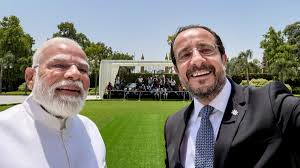
India and Cyprus elevated their bilateral ties to a Strategic Partnership during the State Visit of the President of Cyprus to New Delhi.
- India and Cyprus elevated their ties to a Strategic Partnership, expanding cooperation in defence, cybersecurity, IMEEC connectivity, trade, digital payments, space, and migration while strengthening India’s Mediterranean and European outreach.
- Cyprus holds strategic importance for India as an EU gateway, a counterbalance to the Turkey-Pakistan axis, a key node in IMEEC, and a strong supporter of India’s UNSC and NSG aspirations.
Key Highlights of the Bilateral Visit:
- Five-Year Defence Roadmap (2026–2031): The nations unveiled a comprehensive framework to boost collaboration between the Cyprus Defence & Space Industries Cluster (CyDSIC) and the Society of Indian Defence Manufacturers (SIDM).
- Cyprus expressed a strong interest in procuring Indian military hardware, including drones and advanced missile systems, recently tested during Operation Sindoor.
- This positions Cyprus as a strategic entry point for Indian defense exports into the European market.
- Counter-Terrorism and Cyber Security: A Memorandum of Understanding (MoU) was signed to establish a Joint Working Group on Counter-Terrorism, alongside a dedicated Cybersecurity Dialogue to combat modern digital and geopolitical threats.
- Cyprus appreciated India’s contribution to the UN Peacekeeping Force in Cyprus (UNFICYP).
- Both leaders underscored the critical role of Cyprus in the India-Middle East-Europe Economic Corridor (IMEC).
- Indo-Pacific Oceans Initiative (IPOI): Cyprus joined the Indo-Pacific Oceans Initiative under the Pillar “Trade, Connectivity and Maritime Transport.”
- The visit welcomed the interoperability of India’s Unified Payments Interface (UPI) with the Target Instant Payment Settlement (TIPS) system of the European Central Bank, facilitating seamless financial flows between India and Europe.
- Cyprus announced plans to open a Cyprus Trade Center in Mumbai to enhance trade and investment links.
- India and Cyprus agreed to ensure timely implementation of the India-Cyprus Joint Action Plan 2025–2029 to deepen cooperation across strategic sectors.
- India announced the gifting of a BHISM (Bharat Health Initiative for Sahyog Hita & Maitri) Cube – a state-of-the-art indigenous mobile hospital) to Cyprus.
- The two nations celebrated the first-ever India-Cyprus Space Day (18th May 2026) to foster technological and research collaboration.
- Both countries agreed to establish a Consular Dialogue to strengthen coordination on mobility, visas, and people-to-people ties.
- Both sides agreed to expedite the conclusion of a Migration and Mobility Partnership and a Social Security Agreement to benefit the 15,500-strong Indian diaspora residing in Cyprus.
RBI Forms Q-SAFE Committee:
The Reserve Bank of India (RBI) constituted an eight-member Expert Committee for a Quantum Secure and Adaptive Financial Ecosystem (Q-SAFE) to explore the benefits, risks and challenges of quantum technology in the financial sector.
- Rationale: Quantum Technology uses principles of quantum mechanics such as superposition and entanglement, enabling solutions for complex financial problems like portfolio optimisation, risk assessment and macroeconomic modelling.
- Quantum technology may undermine existing cryptographic standards, creating security risks for banking, payments and the wider financial ecosystem.
- The committee will evaluate the financial sector’s cryptographic inventory through a Cryptography Bill of Materials (CBOM) and assess crypto agility.
- Crypto agility is the ability of a system to quickly shift from vulnerable cryptographic methods to safer alternatives without major disruption.
- It will identify critical financial systems and processes that may be vulnerable to quantum-related cyber threats.
- The panel will assess industry readiness for quantum-safe cryptography, including vendor tools, and undertake cross-country analysis of regulatory frameworks for safe quantum deployment.
- The committee will recommend a roadmap to quantum-secure India’s financial system and submit its report within six months of its first meeting.
AYUSHEXCIL and Spices Board Sign MoU:
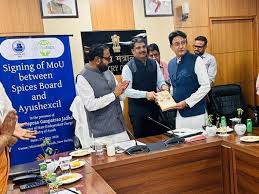
A Memorandum of Understanding (MoU) was signed between Ayush Export Promotion Council (AYUSHEXCIL) and the Spices Board of India to strengthen the global promotion of Ayush products, medicinal spices and India’s traditional wellness ecosystem.
- The partnership aims to promote global cooperation in Ayush products and medicinal spices by strengthening export promotion, quality assurance, standardisation, research, innovation and international market development.
- The collaboration will work on quality enhancement, traceability, scientific validation, capacity building, Codex engagement, branding initiatives and joint participation in international trade fairs.
- It will support functional foods, nutraceuticals, herbal extracts and value-added Ayurvedic and spice-based products.
- The proposed “Spice and Heal” initiative is expected to act as a branding campaign to position India as a global leader in holistic health and natural healing solutions.
- The partnership is expected to benefit farmers, MSMEs, startups, women entrepreneurs, exporters and stakeholders across the Ayush and spice sectors.
- AYUSHEXCIL is an Export Promotion Council supported by the Ministry of Commerce and Industry and the Ministry of Ayush, and was incorporated as a Section 8 company in 2022.
- It oversees exports of Ayurveda, Homoeopathy, Siddha, Sowa-Rigpa and Unani products and addresses trade-related issues in these sectors.
Antiviral Drug Ensitrelvir:
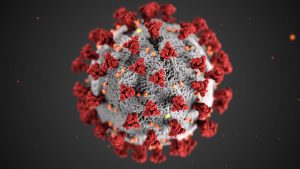
A recent study published in The New England Journal of Medicine reported that the antiviral drug Ensitrelvir significantly reduced symptomatic COVID-19 infections among exposed household contacts.
- Ensitrelvir is an oral antiviral drug that inhibits the SARS-CoV-2 main protease (3C-like protease/Mpro), an enzyme essential for viral replication.
- By blocking this protease, the drug prevents the coronavirus from processing viral proteins required for multiplication inside human cells.
- Aim:
- To treat mild-to-moderate COVID-19 infections and reduce viral transmission after exposure.
- To provide a safer and longer-lasting oral antiviral option without requiring booster drugs like ritonavir.
- Key Features:
- Protease Inhibitor Mechanism: Targets the SARS-CoV-2 main protease (Mpro), preventing viral replication.
- Oral Antiviral Drug: Can be administered orally, making it suitable for outpatient and household use.
- Broad Variant Activity: Showed effectiveness against multiple SARS-CoV-2 variants, including Omicron.
- Better Safety Profile: Remains longer in the bloodstream without requiring ritonavir and avoids the bitter aftertaste associated with some COVID antivirals.
The Pradhan Mantri Anusuchit Jaati Abhyuday Yojna (PM-AJAY):

The Ministry of Social Justice and Empowerment launched the centralized PM-AJAY Portal and the AJAY Mobile Application.
- The Pradhan Mantri Anusuchit Jaati Abhyuday Yojna (PM-AJAY) is a comprehensive, 100% Centrally Sponsored flagship umbrella welfare initiative.
- It was formed by consolidating three erstwhile independent Centrally Sponsored Schemes to eliminate administrative fragmentation and maximize resource utilization:
- Pradhan Mantri Adarsh Gram Yojana (PMAGY)
- Special Central Assistance to Scheduled Castes Sub Plan (SCA to SCSP)
- Babu Jagjivan Ram Chhatrawas Yojana (BJRCY)
- Launched In: Financial Year 2021-22.
- Nodal Agency: Department of Social Justice and Empowerment
- The scheme aims to reduce poverty among Scheduled Caste (SC) communities by generating sustainable livelihood opportunities through skill development and income-generating assets.
Key Features:
- The PM-AJAY framework functions through three primary operational pillars:
- Development of SC-Dominated Villages into an “Adarsh Gram“:
- Target villages with a Scheduled Caste population of more than 40% (and a total population of 500 or more) are selected to be developed into model villages.
- It provides a dedicated gap-filling infrastructure grant of ₹2 lakh per village along with ₹1,00,000 for local administrative costs.
- Progress is monitored against 50 socio-economic indicators across 10 developmental domains, including drinking water, sanitation, literacy, clean fuel, and financial inclusion.
- Grants-in-Aid for District/State-Level Socio-Economic Projects:
- Provides financial assistance directly for comprehensive livelihood initiatives, skill development classes, and income-generating assets for SC households living below the poverty line (BPL).
- The new PM-AJAY Portal functions as a centralized Management Information System (MIS) to track state-wide financial allocations and match implementation schedules with real-time fund flows.
- Construction of Hostels in Educational Institutions:
- Funds the construction of secure hostels in high-quality schools and top-ranked higher educational institutions as listed under the National Institutional Ranking Framework (NIRF).
- The newly launched AJAY Mobile App allows field inspectors to upload mandatory, geo-tagged, and time-stamped photographs directly from project sites to visually validate construction milestones before releasing subsequent funding installments.
- Development of SC-Dominated Villages into an “Adarsh Gram“:
The BRICS 2026 Tourism Working Group (TWG):
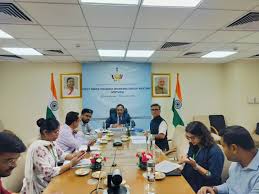
India officially commenced its tourism agenda under its BRICS 2026 Chairship by hosting the inaugural Tourism Working Group (TWG) meeting via virtual mode.
- The BRICS Tourism Working Group is a specialized sector-specific ministerial track operating within the BRICS framework. It brings together tourism administrators, policymakers, and industry experts from member nations to co-create unified travel frameworks, share technological best practices, and expand institutional hospitality capacities.
- The core objective of the 2026 TWG under India’s leadership is to systematically establish a modern, digitized, and highly sustainable intra-BRICS travel corridor.
- It focuses on reviving tourism economies from lingering pandemic trailing shocks and global supply uncertainties through green transitions and digital public integration.
Key Features & Priorities:
- Artificial Intelligence Integration: Standardizing the deployment of AI-driven visitor advisory systems, predictive tourism flow algorithms, and smart hospitality infrastructure.
- Sustainability & Responsible Tourism: Enforcing low-carbon travel footprints, waste reduction models in heritage zones, and shifting revenue directly to indigenous communities.
- Tourism Skilling &Capacity Building: Launching collaborative certification networks to upscale the digital literacy and hospitality talents of the multi-national tourism workforce.
- Seamless Travel Facilitation: Streamlining border crossing checkpoints, promoting flexible visa-free or e-visa accessibility models, and accelerating intra-group tourism exchanges.
- The Jaipur Roadmap: The virtual meeting serves as the foundation for the 2nd TWG Meeting and the BRICS Tourism Ministers’ Meeting in Jaipur, where a formal joint ministerial declaration will be finalized.
BRICS 2026:
- BRICS is a premier plurilateral political and economic alliance of major emerging economies representing the Global South. Originally conceived as BRIC in 2006 (Brazil, Russia, India, and China) and expanded in 2010 to include South Africa, the group serves as a counterweight to traditional G7-led Western financial architectures.
- Guided by the central theme “Building for Resilience, Innovation, Cooperation and Sustainability
- The official BRICS 2026 logo combines national hospitality with multilateral partnership:
- The Radiating Petals: Features vibrant multi-colored petals reflecting the flags of the member countries, representing collective diversity and unity.
- The Central Emblem: Showcases the traditional Indian “Namaste” gesture, reflecting India’s civilizational values of warmth, mutual respect, and collaborative dialogue.
The QUAD:
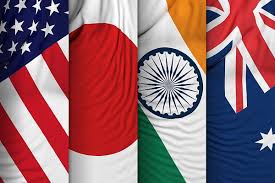
External Affairs Minister Dr. S. Jaishankar hosted the landmark Quad Foreign Ministers’ Meeting (QFMM) at Hyderabad House in New Delhi.
- The Quadrilateral Security Dialogue (Quad) is a premier, non-military plurilateral strategic coalition of four major maritime democracies committed to upholding an open, rules-based, and resilient international order.
- Member Nations: India, the United States, Australia, and Japan.
- The grouping first crystallized as an ad-hoc, informal coordinating maritime coalition to deploy joint Humanitarian Assistance and Disaster Relief (HADR) after the catastrophic Indian Ocean Tsunami.
- The 2007 Initial Dialogue: Formally institutionalized as a diplomatic dialogue by Japanese Prime Minister Shinzo Abe on the sidelines of the ASEAN Regional Forum in Manila, but quickly went into a decade-long hiatus due to regional geopolitical shifts.
- The 2017 Resuscitation: Upgraded and revived at the senior official level during the East Asia Summit in Manila to counter expanding aggressive posturing in Asian sea lanes.
- The 2021 Leadership Elevation: Transitioned into a core, permanent fixture of global governance with the launch of the first virtual Quad Leaders’ Summit on March 12, 2021, moving the framework beyond standalone ministerial talks.
- Aim:
- To ensure a free, open, inclusive, and resilient Indo-Pacific region based on sovereignty, freedom of navigation, and peaceful dispute resolution.
- To provide transparent alternatives to coercive economic and strategic practices.
Medical Innovations Patent Mitra: Innovators-to-Industry (I2I) Connect:
The Indian Council of Medical Research launched India’s largest biomedical innovation and technology transfer platform, “Medical Innovations Patent Mitra: Innovators-to-Industry (I2I) Connect,” in New Delhi.The Medical Innovations Patent Mitra initiative is a structured biomedical innovation and technology transfer platform launched by Indian Council of Medical Research to bridge the gap between scientific research and industry commercialization.It aims to accelerate the development, manufacturing, and public deployment of indigenous healthcare technologies through industry partnerships.



