
Today’s Current Affairs: 17th December 2025 for UPSC IAS exams, State PSC exams, SSC CGL, State SSC, RRB, Railways, Banking Exam & IBPS, etc
Table of Contents
Red-Shanked Douc Monkey:
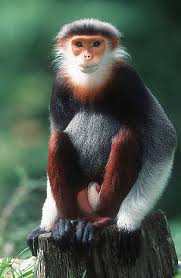
Customs officials at the Kempegowda International Airport (KIA) arrested a passenger who was smuggling two red-shanked douc monkeys.
- It is an Old World monkey which is considered as a “Queen of primates”.
- They occur in subtropical and tropical broadleaf evergreen or semi-deciduous forests and to a lesser extent in secondary evergreen and mixed bamboo forests.
- Red-shanked doucs are found in Southeast Asia mainly in Vietnam, Southern Laos and Cambodia.
- Red-Shanked Douc Monkey is referred to as “the costumed ape,” the red-shanked douc langur is among the most colorful of primates.
- These are arboreal, herbivores and diurnal monkeys that eat and sleep in the trees of the forest.
- They communicate with each other using various facial expressions.
- Conservation Status: IUCN: Critically Endangered
- Hunting is the main threat – for subsistence use and traditional medicine – they are also hunted for the international pet trade.
Dandami Madia Tribe:
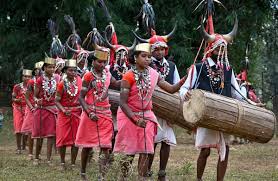
Members of the Dandami Madia tribe perform the traditional Bison Horn Maria dance during a village festival at Judiya Para in Jagdalpur.
- Dandami Maria, also known by other names like Bison Horn Maria and Khalpati Maria, is a tribal community of Chhattisgarh.
- They have derived their name from their unique custom of wearing a distinctive head-gear, which resembles the horns of a wild bison.
- They generally wear head-gear during ceremonies.
- They identify themselves as part of the larger Gond tradition.
- The main distinct language spoken by this tribe is Dandami Maria. Some of them speak Gondi dialects, which is an oral language of Dravidian origins.
- They practice agriculture, supplemented by hunting and fishing.
- Their belief is a combination of Hinduism with Animistic beliefs.
- Their ghotul (youth dormitory for unmarried boys and girls) is an important social institution.
- They perform the traditional Bison Horn Maria dance.
Perumbidugu Mutharaiyar:
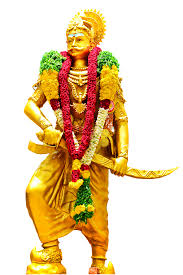
A commemorative postage stamp in honour of the king Perumbidugu Mutharaiyar II (Suvaran Maran) was released by Vice President of India.
- Perumbidugu Mutharaiyar (705 AD-745 AD), also known as Suvaran Maran, was a ruler of the Mutharaiyar lineage.
- Suvaran Maran was also known as Shatrubhayankar.
- Perumbidugu Mutharaiyar fought several battles alongside the Pallava king Nandivarman, and is remembered as a great administrator.
- He seems to have patronised Shaivya and other scholars.
- As a Jain monk Vimalachandra visted his court.
- Mutharaiyars were the feudatories of the Pallavas.
- As the Pallavas’ rule weakened, many such chiefs earned more power and prominence and were treated as rulers in their own right.
- The Mutharaiyars held sway over areas including Thanjavur, Pudukkottai, Perambalur, Tiruchirappalli, and others near the Cauvery river.
- As the feudatories of the Pallavas, the Mutharaiyars were great temple builders.
- They were “engaged in cave temple enterprises up to the opening decades of the ninth century.
Jordan : PM Of India Visit

The Prime Minister of India has embarked on a three-nation visit to Jordan, Ethiopia and Oman.
- It is a landlocked country located in the rocky desert of the northern Arabian Peninsula.
- It is bordered by 5 Nations: Syria in the north, Iraq in the east, Saudi Arabia in the south and southeast and Israel and Palestine in the west.
- Surrounding Water bodies: Dead Sea, the Gulf of Aqaba and the Sea of Galilee.
- Al-Aqabah, the only port of Jordan is located in the south-western part of the country along the coasts of the Gulf of Aqaba.
- Capital City: Amman
- It has arid desert plateau; a great north-south geological rift along the west of the country is the dominant topographical feature.
- Highest Point: Jabal Umm ad Dami is the highest point of Jordan.
- Its main river is Jordan River which drains into the Dead Sea.
- It mainly consists of phosphates, potash and shale oil.
Chakrashila Wildlife Sanctuary:

Community-led conservation efforts at the Chakrashila Wildlife Sanctuary have successfully restored wild honey bee colonies and revitalized associated wildlife.
- It is locatеd in thе Kokrajhar and Dhubri districts of Assam.
- The sanctuary is well-known as the second protected habitat for the endangered golden langur.
- There are two lakes (Dheer Beel and Diplai Beel) on either side, which are integral to the ecosystem of the sanctuary.
- The vegetation of the sanctuary is predominantly tropical moist deciduous forests, mixed deciduous forests, and semi-evergreen forests.
- Sal tree is a dominant tree in this forest.
- It is home to various species, including elephants, tigers, leopards, clouded leopards, sambar deer, barking deer, and gaur.
- The sanctuary is also home to several species of birds, including the endangered Bengal Florican, Great Hornbill, and White-winged Wood Duck.
Man-Portable Air Defence Systems:

The Indian Army is undertaking a major strategic shift in its air defence operations, repurposing its Man-Portable Air Defence Systems (MANPADS) to specifically counter the rising threat of sub-sonic cruise missiles.
- MANPADS are surface-to-air missiles that can be fired by an individual or a small team of people against aircraft.
- These weapon systems often are described as shoulder-fired anti-aircraft missiles.
- The United States and the Soviet Union first deployed MANPADS—the Redeye and Strela systems, respectively—in the 1960s to provide their infantries with portable anti-aircraft weapons.
- The militaries of many countries across the world operate MANPADS, although only few countries, including India, produce them.
- The most famous MANPADS are the US-made ‘Stinger’ and the Soviet 9K32 Strela-2, or simply ‘SA-7′ with the China-made ‘FN-16’ being the latest entrant.
- Three general types of MANPADS exist: command line of sight, laser guided, and infrared seekers.
- Command line-of-sight MANPADS are guided to their targets through the use of a remote control.
- Laser-guided or laser beam rider MANPADS follow a laser projected onto the target.
- The most common MANPADS, frequently called heat seeking missiles, however, are infrared seekers that acquire their target by detecting the heat of an aircraft’s engine.
- Most MANPADS consist of:
- a missile packaged in a tube;
- a launching mechanism (commonly known as a “gripstock”); and
- a battery.
Black-capped Capuchin Monkey:
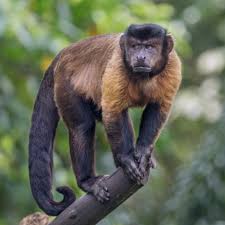
The Bannerghatta Biological Park (BBP) has imported eight black-capped capuchin monkeys (Sapajus apella) from South Africa under an animal exchange programme.
- Black-capped capuchin (Sapajus apella) is also known as tufted capuchins.
- It is native to South America, where they are ubiquitous throughout the Amazon River Basin.
- It is mainly found in tropical, subtropical, dry, submontane, savannah, mangrove forests.
- Behavior and Lifestyle of Black-capped Capuchin Monkey:
- Black-capped capuchins are predominantly arboreal and diurnal species.
- Communication: Black-capped capuchin monkeys communicate with one another through vocalizations, body language, tactile methods, and olfactory cues.
- It is classified as omnivores, their diet consists of fruit, seeds, nuts, insects, lizards, eggs and crustaceans.
- Ecological Role: Feeding upon fruit, the capuchins become seed dispersers of certain forest plants.
- Conservation Status: IUCN: Least Concern
- Bannerghatta Biological Park has been an integral part of Bannerghatta National Park and emerged out as an independent establishment in 2002.
Dieback Disease:
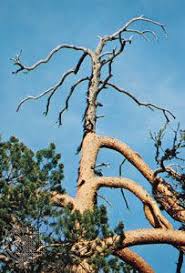
The withering of thousands of neem trees over some years had prompted the Mulugu-based Forest College & Research Institute (FCRI), to launch a comprehensive scientific probe into the devastating “dieback disease.”
- It is a fungal disease which kills a wide variety of plants.
- It is responsible for causing wilting and browning of leaves from the tip of the branch, stem canker, and fruit rot.
- It was first reported in the country during the 1990s in Uttarakhand.
- The dieback fungus belongs to the genus Phytophthora
- The fungus is spread through the movement of soil and mud, especially by vehicles and footwear.
- It also moves in free water and via root-to root contact between plants.
- The fungus lives in susceptible plant tissue and soil, and migrates and reproduces in warm, moist conditions.
- Infected roots cannot provide the water and nutrients needed to maintain life, and the plants die from dehydration.
- It causes almost 100% loss of fruit production in severely infected trees.
- Where the disease occurs, the native vegetation can become devastated, and the delicate fabric of ecosystems seriously impaired; certain species can disappear from the area.
- The appearance of symptoms starts with the onset of the rainy season and becomes progressively severe in the later part of the rainy season and early winter.
- There is no known cure for the disease.
United Nations Alliance of Civilization:

India reaffirmed its commitment to the ideals of Vasudhaiva Kutumbakam and religious harmony at the 11th United Nations Alliance of Civilizations, UNAOC, forum in Riyadh.
- It was established in 2005, as the political initiative of Mr. Kofi Annan, former UN Secretary-General.
- It was co-sponsored by the Governments of Spain and Turkey.
- It was created to serve as a soft-power political tool of the United Nations Secretary-General for conflict prevention and conflict resolution.
- It maintains a global network of partners including states, international and regional organizations, civil society groups, foundations, and the private sector to improve cross-cultural relations between diverse nations and communities.
- The Global Forum is the highest-profile event of the UNAOC which brings together prominent personalities, current and potential partners, and others from different sectors.
- The Secretary-General has established a voluntary Trust Fund for UNAOC.
- This fund supports the UNAOC projects, activities and outreach, undertaken by the High Representative for the United Nations Alliance of Civilizations in his official capacity, and core operational and human resources needs.
- The Trust Fund for UNAOC is administered by the United Nations Secretariat in accordance with the United Nations Financial Regulations and Rules.
- UNAOC receives voluntary contributions from member states, international organizations, private sector and foundations.
- Secretariat: It is based in New York, USA.
Gestational Diabetes Mellitus:

A study conducted at seven antenatal clinics with over 3,000 women, found that early gestational diabetes mellitus (GDM) affects about one in five pregnant women.
- Gestational Diabetes Mellitus (GDM) is glucose intolerance first diagnosed during pregnancy, and is typically diagnosed between 24-28 weeks gestation.
- It happens when the hormones from the placenta block ability to use or make insulin.
- The placenta supplies a growing fetus with nutrients and water, and also produces a variety of hormones to maintain the pregnancy.
- This is called contra-insulin effect, which usually begins about 20 to 24 weeks into the pregnancy.
- Most of the time, gestational diabetes doesn’t cause symptoms but it includes excessive thirst, urinating more often, fatigue, nausea.
- Risk factors that can increase the chances of developing GDM which includes:
- Overweight or obesity
- Being over the age of 45
- Having a family history of diabetes or gestational diabetes in a previous pregnancy
- Having Polycystic Ovary Syndrome (PCOS)
- Treatment: Gestational diabetes can be managed with a combination of lifestyle changes and medication.



