
Jallianwala Bagh Massacre 1919:
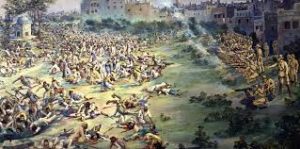
On 13th April 2026, the nation paid homage to the martyrs of the Jallianwala Bagh massacre, marking the 107th anniversary of one of the darkest chapters in India’s colonial history.
Jallianwala Bagh Massacre:
- The Rowlatt Act, 1919 (formally known as the Anarchical and Revolutionary Crimes Act, 1919) was passed based on the Sedition Committee’s recommendations.
- It authorized the British colonial government to imprison suspected political subversives without trial for up to two years.
- In response to the Rowlatt Act (1919), Mahatma Gandhi organized a nationwide hartal on 6th April 1919, marking the first all-India mass protest. He strongly opposed the Act, calling it a “Black Law,” and the day came to be known as Black Day.
- Tensions were particularly volatile in Punjab.
- On 9th April two prominent local nationalist leaders Dr. Saifuddin Kitchlew and Dr. Satyapal were secretly arrested and deported for organizing peaceful protests.
- The public anger led to riots in Amritsar.
- The British administration handed control of the city to Brigadier General Reginald Edward Harry Dyer, who practically imposed martial law, banning all public gatherings.
- 13th April 1919 coincided with Baisakhi, a major harvest festival. Thousands of men, women, and children gathered in Jallianwala Bagh, an enclosed public ground in Amritsar.
- Many were villagers unaware of Dyer’s ban on public assemblies, while a smaller contingent was there to peacefully protest the arrest of their leaders.
- General Dyer arrived with a detachment of Gurkha and Baloch.
- He deliberately blocked the main, narrow entrance with his forces and armored vehicles.
- Without issuing any warning to disperse, Dyer ordered his troops to open fire on the dense, unarmed crowd. Over 1,000 men, women, and children were killed.
- Hunter Commission (Disorders Inquiry Committee): Appointed in 1919 to investigate the massacre.
- While it censured Dyer for his actions and forced his resignation from the military, it recommended no penal or legal action against him.
- The Congress boycotted the Hunter Commission and set up its own non-official committee, comprising leaders like Mahatma Gandhi, Motilal Nehru, C.R. Das, and Abbas Tyabji, which condemned the act as a calculated piece of inhumanity.
- Aftermath:
- High-Profile Renunciations: In profound protest, Rabindranath Tagore renounced his British Knighthood, and Mahatma Gandhi returned his Kaiser-i-Hind medal.
- Sir Chettur Sankaran Nair was a prominent Indian nationalist, jurist, and social reformer. He served on the Viceroy’s Executive Council and contributed to the Montagu–Chelmsford Reforms (1919). Following the Jallianwala Bagh massacre, he resigned in protest and, in his book Gandhi and Anarchy (1922), held Michael O’Dwyer responsible, leading to a defamation case in London.
- Although the verdict went against him, his stand exposed colonial bias and strengthened nationalist sentiment.
- Catalyst for Mass Movements: The outrage over Punjab, merged with the Khilafat issue, provided the immediate political capital for Gandhi to launch the Non-Cooperation Movement (1920–1922).
- Rise of Revolutionary Extremism: The trauma deeply influenced a younger generation in Northern India, including Bhagat Singh, accelerating the shift toward militant anti-imperialism via organizations like the Hindustan Socialist Republican Association (HSRA).
- In 1940, Udham Singh (a survivor of the massacre) assassinated Michael O’Dwyer in London. O’Dwyer was the Lieutenant Governor of Punjab in 1919, who had officially endorsed Dyer’s actions.



