
Mahabodhi Temple:
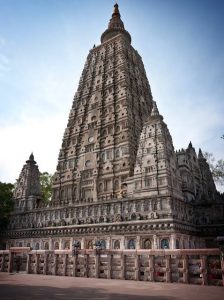
The Mahabodhi Temple received donations worth nearly Rs 2 crore in a six-day census of donation boxes, including Rs 1.5 crore from Indian and Rs 50 lakh from foreign countries.
- Mahabodhi Temple is an ancient Buddhist temple located in Bodh Gaya, Bihar, on the banks of the Niranjana River.
- It is one of the four most sacred sites of Buddhism, marking the location where Buddha attained Enlightenment (Bodhi), along with:
- Lumbini (Buddha’s birthplace)
- Sarnath (Buddha’s first sermon)
- Kushinagar (Buddha’s parinirvana)
- The original temple was constructed by the Mauryan emperor Ashoka in the 3rd century BC.
- The present structure is estimated to have been erected between 5th and 6th century AD during the Gupta Period.
- The temple was heavily restored in the 19th century by Myanmar (Burmese) Buddhists and then by the British archaeologist Sir Alexander Cunningham.
- It was recognized as a UNESCO World Heritage site in 2002.
- It is constructed of brick and is one of the oldest brick structures to have survived in India.
- Its pyramidal shikhara (tower) comprises several layers of niches, arch motifs, and fine engravings.
- Four additional towers, each identical to the main tower but smaller in size, adorn the corners of the two-story structure.
- A shrine inside the temple holds a yellow sandstone statue of the Buddha encased in glass.
- In 2013, the upper portion of the temple was covered with gold, as a gift from the King and devotees of Thailand.
- A descendant of the Bodhi tree under which the Buddha is said to have sat until he attained enlightenment stands adjacent to the temple.
- Vajrasana (Diamond Throne): A stone slab marking the exact spot where Buddha meditated and attained enlightenment, originally installed by Emperor Asoka.
- Stone railings surround the temple as well as the Bodhi tree.
- One of the most famous of Ashoka’s many pillars (on which he had engraved his proclamations and his understanding of religious doctrine) stands at the southeast corner of the temple.



