
Katydids:
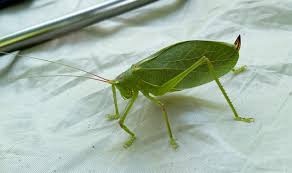
Researchers recently identified three previously unknown species of meadow katydids, or long-horned grasshoppers, named Conocephalus usmanii, Conocephalus nagariensis, and Conocephalus ganderbali, in Jammu and Kashmir.
- Katydids found on every continent except Antarctica, Katydids are a family of primarily nocturnal insects.
- They belong to the family Tettigoniidae.
- Grasshoppers, locusts, crickets, and katydids belong to a group of insects known as orthopterans (meaning ‘straight wings’).
- They closely resemble grasshoppers and used to go by the name long-horned grasshoppers.
- However, in reality, they are more closely related to crickets, hence their other common name, the bush cricket.
- They are famous for their ability to blend into their surroundings.
- They are mostly herbivores, feeding on leaves, flowers, and fruit, but some eat small insects.
- Meadow Katydids are a group of species of slender, small-to medium-sized katydids found in grassy meadows near lakes and ponds.
- When disturbed, they enter the water, cling to underwater plants, and can remain submerged for several minutes.
- Abundant and widespread, meadow katydids have large orange eyes and a body that is brown on top and green on the bottom.
- They produce a song, consisting of clicks and buzzes, during the day or at night.
- Conocephalus nagariensis, Conocephalus ganderbali and Conocephalus usmanii are katydids.