
Somnath Swabhiman Parv:
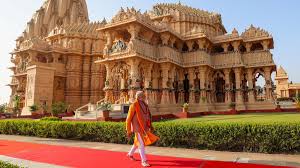
The Prime Minister stated that the thousand-year survival of the Somnath temple symbolizes India’s indomitable spirit, as the nation celebrates Somnath Swabhiman Parv (1026–2026) for a millennium of unbroken faith and resilience.
- The Somnath Temple, located at Prabhas Patan on Gujarat’s coast, is the first Jyotirling among the 12 holy Shiva Jyotirlingas, as stated in the Shiva Purana and Dwadasha Jyotirling Stotram.
- It is also the Neejdham Prasthan Leela site where Lord Shri Krishna took his last journey.
- Identified as a Tirthdham of immense antiquity, revered alongside Ganga, Yamuna, and Saraswati in Vedic literature.
- According to tradition, it was built in phases—first in gold by Somraj (Moon God), then in silver by Ravana, later in wood by Lord Krishna.
- King Bhimdev I (or Bhima I) of the Solanki dynasty rebuilt the temple in stone after its destruction by Mahmud of Ghazni in 1026 CE.
- Situated at the confluence of Kapila, Hiran, and Saraswati rivers with the Arabian Sea.
- Abadhit Samudra Marg (Tirth Stambh) indicates an uninterrupted sea route to the South Pole, with the nearest landmass ~9,936 km away, reflecting ancient Indian geographical knowledge.
- It is built in the Kailas Mahameru Prasad style. The structure includes Garbhgruh, Sabhamandap, and Nrityamandap. It has a 155-foot-high Shikhar.
- First major attack in 1026 AD by Mahmud of Ghazni; documented by Persian scholar Al-Biruni.
- The temple was looted and destroyed multiple times, including in 1026, 1297, 1394, and 1706 CE (Aurangzeb). 2026 marks 1,000 years since the first attack, a significant civilisational milestone.
- The 7th existing temple was rebuilt post-independence as a symbol of national resurgence. Sardar Vallabhbhai Patel initiated the reconstruction in 1947.
- The Pran-Pratistha was performed by President Dr. Rajendra Prasad on 11th May, 1951. Reconstruction was supported by KM Munshi, author of “Somanatha: The Shrine Eternal”.
- Visited by Swami Vivekananda in 1890s, who described Somnath as embodying India’s national life-current—destroyed and reborn repeatedly.
Revered by saints across traditions, including Jain Acharya Hemchandracharya. - Maintained ritual continuity by Maharani Ahilyabai Holkar during adverse political conditions.
- Somnath symbolises faith over fanaticism, creation over destruction, and the eternity of Indian civilisation, echoing the Gita’s message of the indestructible soul.