
Today’s Current Affairs: 2nd December 2025 for UPSC IAS exams, State PSC exams, SSC CGL, State SSC, RRB, Railways, Banking Exam & IBPS, etc
Table of Contents
Heron Mk II:

To enhance their unmanned capabilities in the wake of Operation Sindoor, the Indian armed forces have signed up for more satellite-linked Heron Mk II UAVs under emergency procurement.
- It is a Medium-Altitude Long-Endurance (MALE) Unmanned Aerial Vehicle (UAV).
- It was developed by Israel Aerospace Industries (IAI).
- It offers an endurance of 45 hours and a top speed of 150 knots.
- It can reach altitudes up to 35,000 ft and has an operating range of more than 1,000 km.
- It can carry long-range radars and observation sensors, such as electro-optical/infra-red (EO/IR) systems for detection and tracking of targets.
- The Electronic Intelligence (ELINT) and Communications Intelligence (COMINT) systems will be installed on board to detect, analyse, geolocate, and gather electronic and communication radio signals for actionable intelligence at long-range stand-off distances.
- It is able to gather intelligence from tens of kilometers away without crossing borders.
Sanchar Saathi:

The Department of Telecommunications (DoT) has made it mandatory for all newly manufactured or imported mobile phones in India to come with the Sanchar Saathi app pre-installed.
- It is a security and awareness platform developed by the Department of Telecommunications (DoT).
- It is available both as an app and a web portal.
- Purpose is to help mobile users manage their digital identity, report suspicious activity, and safeguard their devices.
- The platform also provides educational material on telecom safety and cyber risks, making it a combined service-and-awareness system.
- Features:
- ‘Chakshu’ feature: It lets users report suspicious calls, SMS and WhatsApp messages, such as fake KYC alerts, impersonation scams, or phishing links. It helps authorities spot fraud patterns.
- Report spam and unwanted commercial calls: Users can report spam calls and messages that break TRAI rules. Complaints made within seven days can lead to action against the sender.
- Report malicious links and apps: Allows reporting of phishing links, unsafe APKs, and fraudulent websites.
- Checking mobile connections linked to your identity: Shows how many mobile numbers are registered using your identity. Helps identify SIM cards taken without your knowledge.
- Blocking lost or stolen phones: Allows users to block the IMEI of a lost or stolen device so it can’t be used. Phones can be unblocked if recovered.
- Verifying the authenticity of a device: Allows users to check if a phone is genuine by validating its IMEI. It is useful when buying second-hand phones.
- Reporting international calls that appear as Indian numbers: Some scammers use illegal telecom setups to make international calls appear as regular +91 calls. Sanchar Saathi enables users to report such cases.
- Finding your local Internet Service Provider: The app also includes a feature that lets users check which wired internet service providers are available in their area by entering a PIN code, address, or provider name.
- Verifying trusted contacts and helpline numbers: Provides a directory to confirm genuine customer-care numbers, emails, and websites of banks and other major institutions.
Bioremediation:

Bioremediation offers a cheaper, scalable, and sustainable alternative, especially in a country like India where vast stretches of land and water are affected but resources for remediation are limited.
- Bioremediation literally means “restoring life through biology.”
- It is the use of living organisms, primarily microorganisms, to degrade environmental contaminants into less toxic forms.
- It is used to clean up contaminated soil, air, and water.
- It harnesses microorganisms such as bacteria, fungi, algae, and plants to sequester or transform toxic substances such as oil, pesticides, plastics, or heavy metals.
- These organisms metabolise these pollutants as food, breaking them down into harmless by-products such as water, carbon dioxide, or organic acids.
- In some cases, they can convert toxic metals into less dangerous forms that no longer leach into the soil or groundwater.
- Two Broad Types of Bioremediation:
- In situ bioremediation, where treatment happens directly at the contaminated site, such as when oil-eating bacteria is sprayed on an ocean spill;
- Ex situ bioremediation, where contaminated soil or water is removed, treated in a controlled facility, and returned once cleaned.
- Advantages:
- It cleans up the environment naturally without the use of toxic chemicals. So, it is an environmentally friendly
- It is cost-effective, as extensive equipment and labor are not needed.
- It is a recommended method for removing oil stains.
- Disadvantages:
- It is limited to the compounds which are degradable.
- It is not able to remove all kinds of impurities from the contaminated site. Like, some kind of inorganic contaminants cannot be treated with this bioremediation method.
- Some heavy metals cannot be completely broken down, resulting in toxic by-products.
Biological Weapons Convention:

The External Affairs Minister recently called for urgent reforms to strengthen global biosecurity and modernise the Biological Weapons Convention (BWC), warning that biological threats are becoming harder to manage in a rapidly evolving scientific landscape.
- It is a legally binding international treaty that bans the use of biological and toxin weapons and prohibits all development, production, acquisition, stockpiling, or transfer of such weapons.
- The treaty also bans any equipment or means of delivery that is designed to use biological agents or toxins for hostile purposes or armed conflict.
- It requires signatories to destroy biological weapons, agents, and production facilities within nine months of the treaty’s entry into force.
- It opened for signature in 1972 and entered into force in 1975.
- It was the first multilateral treaty categorically banning a class of weapon.
- It currently has 187 states-parties, including Palestine, and four signatories (Egypt, Haiti, Somalia, and Syria).
- Ten states have neither signed nor ratified the BWC (Chad, Comoros, Djibouti, Eritrea, Israel, Kiribati, Micronesia, Namibia, South Sudan, and Tuvalu).
- India signed and ratified the BWC in 1974.
- The convention stipulates that states shall cooperate bilaterally or multilaterally to solve compliance issues.
- States may also submit complaints to the United Nations Security Council (UNSC) should they believe another state is violating the treaty.
- However, there is no implementation body of the BWC.
- There is a review conference every five years to review the convention’s implementation, and establish confidence-building measures.
- Biological weapons disseminate disease-causing organisms or toxins to harm or kill humans, animals, or plants.
- They generally consist of two parts – a weaponized agent and a delivery mechanism.
- Almost any disease-causing organism (such as bacteria, viruses, fungi, prions, or rickettsiae) or toxin (poisons derived from animals, plants, or microorganisms, or similar substances produced synthetically) can be used in biological weapons.
Masala Bonds:

The Enforcement Directorate’s (ED) recent decision to issue notices to the Kerala Chief Minister in the KIIFB masala bond investigation marks a significant escalation in a long-running conflict between the LDF government and central agencies over the state’s financing model.
- They are rupee-denominated bonds issued outside India by Indian entities.
- The International Finance Corporation (IFC), an arm of the World Bank, issued the first masala bonds in 2013 as part of its $2 billion dollar offshore rupee programme.
- They are debt instruments which help to raise money in local currency from foreign investors.
- That means the currency risk, if exchange rates change, is on the investor, not the issuer. This helps Indian companies manage their risks better.
- To offset the risk of exchange rate fluctuations, bonds typically offer attractive interest rates that are frequently greater than those offered in the investors’ home countries.
- Both the government and private entities can issue these bonds.
Guinea-Bissau:

The African country of Guinea-Bissau fell under the military rule.
- It is one of the smallest countries in the African continent.
- It borders Senegal to the north and Guina to its eastern and southern boundaries.
- Maritime Boundary: To the west, the country has a coastline on the Atlantic Ocean.
- It includes the Bijagos (Bissagos) archipelago and other islands that lie off the coast.
- Capital City: Bissau
- Geographical Features of Guinea-Bissau
- Terrain: Mostly low-lying coastal plain with a deeply indented estuarine coastline rising to savanna in east.
- Plateau: The Fouta Djallon Plateau dominates the southeastern part of the country.
- Climate: It has a generally tropical climate influenced by the intertropical convergence zone (ITCZ).
- Its environment is largely made up of swamps and marshlands.
- Rivers: Corubal, Geba, and Cacheu ETC.
- Natural resources: Phosphates, bauxite, clay, granite, limestone.
- Economy: Fishing is a huge local industry of this country.
Trade Enablement and Marketing Scheme:

The Minister of State for Micro, Small & Medium Enterprises informed the Rajya Sabha about the Trade Enablement and Marketing Scheme.
- It is the sub scheme of the scheme ‘Raising and Accelerating MSME Performance’ (RAMP), which is a Central Sector Scheme.
- It will empower MSMEs with digital tools and guidance to effectively utilize the e-commerce marketplace.
- Objective is to support MSMEs to help them access different markets by integrating them with e-commerce platforms.
- All the Udyam registered Micro and Small Enterprises (MSEs) under manufacturing and services sectors will be eligible for benefits under the Initiative.
- It will focus on:
- connecting MSMEs with the ONDC Network.
- providing access to digital storefronts, integrated payment systems, and logistics support.
- reducing operational barriers and helps businesses tap into wider customer bases.
- emphasizing formalization of operations and establishing digital transaction histories, which will enhance the credibility and trust of participating MSMEs.
- Implementing Agency: National Small Industries Corporation (NSIC).
Exercise EKUVERIN: 14th edition
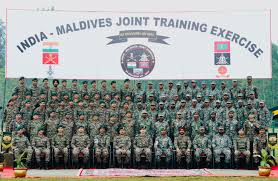
The 14th edition of the exercise EKUVERIN is set to take place in Thiruvananthapuram, Kerala.
- Ekuverin meaning ‘Friends’ in Dhivehi language.
- It is one of the three major joint exercises between India and the Maldives.
- It is a bilateral military annual exercise conducted alternatively in India and Maldives.
- It aims to enhance interoperability while carrying out counterinsurgency and counter terrorism operations in semi-urban, jungle and coastal terrain.
- It also focuses on integration of niche technology to enhance interoperability, the countries will share best practices, reflecting the shared commitment of India and the Maldives towards peace and security in the region.
- The two bilateral exercises are “Ekuverin” and “Ekatha” and trilateral- “Dosti”, which includes Sri Lanka.
WorldSkills Asia Competition 2025:

India secured 8th rank in its first-ever participation at the WorldSkills Asia Competition (WSAC) 2025, winning 1 Silver, 2 Bronze, and 3 Medallions for Excellence.
- A premier continental skill competition under the WorldSkills movement, promoting excellence in technical and vocational education (TVET) across Asia.
- It brings together youth to compete in diverse trades—traditional, digital, and emerging.
- WorldSkills Asia (WSA) was established to organize regional contests within Asia.
- First WSAC: 2018, Kuala Lumpur (Malaysia).
- India debuted in 2025 at Chinese Taipei.
- Key Features of WSAC 2025:
- Asia’s largest regional TVET competition under the WorldSkills framework.
- Competitions held across 44 high-demand skills including robotics, industrial design, web tech, software development, electrical installations.
- Focus on:
- Future-ready skills (AI, automation, web tech, robotics).
- Traditional trades (painting, electrical, design).
- Youth employment, TVET reforms, industry-global partnerships.
- Facilitates trainer development, international cooperation, and bridging the education–employment gap.
- India’s Performance:
- Rank: 8th overall among 29 nations.
- Team: 23 competitors in 21 skills, supported by 21 experts
- Led by MSDE & NSDC.
Assam Prohibition of Polygamy Bill, 2025:

The Chief Minister of Assam introduced the Assam Prohibition of Polygamy Bill, 2025 in the Assam Legislative Assembly, aiming to criminalize polygamy across the state, with severe punishments for those violating the law.
Provisions of Assam’s Anti-Polygamy Bill 2025
- Criminalization of Polygamy: The Bill makes polygamy a criminal offence, prescribing imprisonment of up to 7 years and a fine for anyone entering into, or concealing, a second marriage while the first marriage remains valid.
- Exemptions and Jurisdiction: The law excludes the Sixth Schedule areas of Assam, where customary laws permit polygamy.
- Scheduled Tribes under Article 342 of the Constitution are not covered by this law.
- The law applies to Assam residents and extends its jurisdiction to those involved in polygamous marriages outside the state or who benefit from Assam’s welfare schemes.
- Accountability of Key Actors: Village heads, qazis (Muslim clerics), parents, and legal guardians of individuals entering into polygamous marriages will be held accountable.
- Compensation for Affected Women: A compensation mechanism will be established for women who are adversely affected by polygamous marriages.
- Impact on Convicts: Individuals convicted under this law will be ineligible for government jobs, benefits, and government schemes. Election eligibility will be barred for such individuals.
- Grandfather Clause: Polygamous marriages contracted before the law’s enactment will not be impacted as long as they comply with existing personal or customary laws and have valid proof.
Polygamy:
- It refers to the practice of having more than one spouse simultaneously. In this context, polygamy involves a marriage where one person may have multiple partners at the same time.
- Traditionally, polygamy has been practiced in various cultures, with polygyny (a man having multiple wives) being more common in many societies.
- In India, polygamy was widely practiced in the past, especially among men, but the Hindu Marriage Act of 1955 formally prohibited it.
- The Special Marriage Act (SMA), 1954, permits inter-religious marriages, but also explicitly bans polygamy. Many Muslim women have used this Act to prevent or challenge polygamous practices.
WHO Issues First Global Guideline on Infertility:
WHO has released its first-ever global guideline on infertility, calling for safer, fairer and affordable fertility care worldwide.
- It aims to help countries integrate infertility prevention, diagnosis and treatment into public health systems as infertility affects 1 in 6 people globally.
- WHO’s first global framework to standardise prevention, diagnosis and treatment of infertility.
- Seeks to make fertility care accessible, equitable and evidence-based, especially in countries where treatment is unaffordable and fragmented.
- Key Features of the Guideline:
- 40 recommendations covering prevention, early diagnosis, counselling and advanced treatment options.
- Focus on cost-effective infertility care integrated into national health strategies and UHC frameworks.
- Encourages fertility awareness in schools, primary health centres and reproductive health facilities.
- Addresses risk factors such as untreated STIs, tobacco use, poor lifestyle habits.
- Recommends lifestyle interventions—healthy diet, exercise, tobacco cessation—for individuals trying to conceive.
- Provides clinical pathways for diagnosing infertility in both men and women using evidence-based protocols.
- Strong emphasis on psychosocial support, recognising the emotional stress, stigma and mental health burdens linked to infertility.
- Urges countries to adopt a rights-based, gender-equal reproductive health framework.
India Re-elected to IMO Council:
India has been re-elected to the IMO Council in Category B with the highest votes (154/169) for the 2026–27 term. This marks India’s second consecutive highest vote tally, reinforcing its rising maritime influence.The Council is the executive body of the International Maritime Organization, responsible for supervising its work between Assembly sessions and making policy decisions on maritime governance. The Council is constituted under the IMO Convention (1958) and elected every two years by the Assembly. Category B includes 10 nations with the largest interest in international seaborne trade.
India secured 154/169 votes, highest in Category B. Category B Member States: Australia, Brazil, Canada, France, Germany, India, Netherlands, Spain, Sweden and the United Arab Emirates (UAE).
Great Nicobar Crake:
A newly photographed Great Nicobar Crake, possibly a new species of the Rallina genus, has been reported from Great Nicobar Island—only the third photographic record in over a decade.The Great Nicobar Crake is a medium-sized, potentially new Water Crake species (Genus: Rallina) found only in Great Nicobar Island. It may be endemic to the Andaman & Nicobar region and shows several morphological features not seen in known Rallina species.
SIM Binding:
The Union Government has directed messaging apps like WhatsApp, Telegram, Signal and others to mandatorily link their services to the SIM card used during registration.SIM binding is a security mechanism that permanently links a user’s messaging or authentication service to the physical SIM card used during registration. The app stops working if the original SIM is not present in the device, acting as a hardware token for identity verification. Ministry: Department of Telecommunications (DoT), Under the Telecommunication Cybersecurity, Amendment Rules, 2025. Introduced the concept of Telecommunication Identifier User Entity (TIUE) to regulate digital communications more securely.SIM binding is a security process that links a user’s digital identity to the unique identifiers stored inside a physical SIM card. Every SIM contains hardware-level data such as:
- IMSI (International Mobile Subscriber Identity)
- ICCID (Integrated Circuit Card Identifier)
- Ki (authentication key stored in SIM hardware)
When an app implements SIM binding, it continuously checks these SIM identifiers inside the device.
If the app does not detect the same IMSI/ICCID/Ki that were present during registration, it concludes the identity mismatch and automatically blocks access.
26th Edition of Hornbill Festival:
The 26th Hornbill Festival began on 1st December at the Naga Heritage Village in Kisama, Kohima, coinciding with Nagaland’s Statehood Day. This ten-day festival brings together all major Naga tribes to celebrate their rich traditions, music, dance, crafts, and local food. Over the years, the Hornbill Festival has become one of India’s most famous cultural events.The festival’s opening ceremony started at 4:00 PM at Unity Plaza, Kisama. The Governor of Nagaland, Ajay Kumar Bhalla, hosted the event. Visitors enjoyed performances, traditional dances, and other cultural showcases during the inaugural day.
IGI Becomes India’s First Water-Positive Airport:
Delhi’s Indira Gandhi International Airport (IGI) has earned the title of India’s first water-positive airport among facilities handling more than 40 million passengers annually. This certification marks a milestone in sustainable airport operations and environmental stewardship.Being water-positive means the facility replenishes more freshwater than it consumes. IGI achieved this goal by expanding rainwater harvesting, investing in storage systems and adopting advanced recycling mechanisms. The recognition was formally conferred at the Water Innovation Summit 2025 under the NITI Aayog–CII water neutrality framework.
Kochi to Host 7th India International Seaweed Expo & Summit in January 2026:
Kochi is set to welcome one of the world’s largest gatherings of the seaweed industry as it hosts the 7th India International Seaweed Expo and Summit on January 29 and 30, 2026. The event reflects India’s rising focus on the blue economy and emerging opportunities in the marine algae sector. Delegates from Brazil, Sri Lanka, the Netherlands and Sweden will participate in the summit. Researchers, industry associations and government bodies will engage through discussions, exhibitions and collaborations, making Kochi a global hub for seaweed networking and innovation.
IBTP Chief Praveen Kumar Takes Additional Charge as DG of BSF:
Praveen Kumar, the current Director General of the Indo-Tibetan Border Police (ITBP), has now taken additional charge as the Director General of the Border Security Force (BSF). He stepped into this role on Sunday after the retirement of former BSF chief Daljit Singh Chawdhary.The responsibility was officially handed over at a BSF camp in Raipur, Chhattisgarh. Usually, such ceremonies are held at the BSF headquarters in New Delhi. However, this time it took place in Raipur because both officers were attending the DGs-IGs national police conference being held from Friday to Sunday.
Vivek Chaturvedi is Appointed as New CBIC Chairman:
The Government of India has appointed Vivek Chaturvedi, a 1990-batch Indian Revenue Service (Customs & Indirect Taxes) officer, as the new Chairman of the Central Board of Indirect Taxes and Customs (CBIC). His selection was approved by the Appointments Committee of the Cabinet, as mentioned in an order issued by the Department of Personnel & Training (DoPT).Vivek Chaturvedi is a senior IRS officer with more than 30 years of experience in the field of indirect taxes. Over the years, he has worked in several key positions, contributing to tax administration, compliance, and policy matters. His long career in the revenue services has earned him a reputation for leadership and integrity.
World Computer Literacy Day 2025:
World Computer Literacy Day is observed every year on December 2 to promote digital education, technological awareness and equal access to computer skills. It serves as a reminder that in a rapidly digitising world, bridging the digital divide is essential for inclusive growth.World Computer Literacy Day was first introduced in 2001 by NIIT Limited, an Indian multinational organisation specialising in learning and skill development. The initiative originally focused on educating women and children, offering them computer training and expanding access to technology.Celebrated globally, this day also acknowledges the transformative role of computers in economic development, communication, learning, employment and innovation.
UNFPA India Honors IUSSP for 2025 UN Population Award in Institutional Category:
The United Nations Population Fund (UNFPA) India honoured the International Union for the Scientific Study of Population (IUSSP) for winning the 2025 United Nations Population Award in the Institutional Category. The award recognises IUSSP’s outstanding work in population research and support for evidence-based policymaking worldwide.The felicitation was held during the 46th Annual Conference of the Indian Association for the Study of Population (IASP), highlighting important discussions on India’s demographic future.IUSSP, led by Dr. Shireen Jejeebhoy (President, 2022-2025), received the award for its exceptional contributions to global population science and fostering collaboration among demographers.Dr. Jejeebhoy said, “It is an honour for IUSSP to receive this award. Our work in research, capacity building, and global networks is recognised. At a time of changing demographics—from ageing populations to climate-related migration—independent, strong research is more important than ever.”



