
LHS 1903 System:
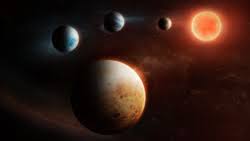
Astronomers utilizing the European Space Agency’s Cheops Space Telescope have discovered a unique four-planet system orbiting the red dwarf LHS 1903, featuring a planetary arrangement that challenges current planet formation theories.
- The system consists of four planets – two Super-Earths (rocky) and two mini-Neptunes (gaseous) orbiting a red dwarf star located 117 light-years from Earth.
- The Formation Paradox: Conventional models suggest rocky planets form near the star, while gas giants form farther away.
However, the outermost (fourth) planet of LHS 1903 is rocky, despite being positioned beyond its gaseous siblings. - Researchers suggest the planets formed one after another, depleting the available gas before the fourth planet formed, or that the fourth planet lost its atmosphere in a catastrophic event, leaving behind a rocky outer planet.
- The rocky planets are classified as Super-Earths, possessing a composition similar to Earth but with a mass two to ten times greater.
- Sub-Neptunian Neighbors: The two middle planets are mini-Neptunes, which are larger than Earth but smaller than Neptune, characterized by thick gaseous envelopes.
- Habitability Potential: The fourth planet is of particular scientific interest due to its estimated surface temperature of 60°C, placing it within a range that could potentially support habitability.
- Star Characteristics: The host star, LHS 1903, is a red dwarf with only 50% of the Sun’s mass and 5% of its luminosity, representing the most common type of star in the Milky Way



