
Mars-Like Conditions in Salar de Pajonales:
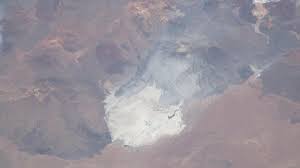
Scientists discovered that in the Salar de Pajonales, a salt flat in the Atacama Desert, gypsum acts as a microscopic shield, protecting living microbes and preserving their ancient fossils.
- Salar de Pajonales is a large playa (salt flat) in northern Chile, situated on the western margin of the Altiplano-Puna plateau at an elevation of approximately 3,500 metres above sea level.
- It is the 3rd-largest salar in the Atacama Region (after Salar de Atacama and Salar de Punta Negra).
- It lies within the hyperarid core of the Atacama Desert and experiences polyextreme conditions, i.e., extreme aridity, high altitude, intense solar and ultraviolet radiation, dramatic temperature fluctuations, and a sulfate-rich mineralogy. These conditions closely mimic those found on Mars.
- It is an endorheic basin (with no outflow) sustained by groundwater. Its surface is dominated by evaporitic deposits, including prominent gypsum (calcium sulfate dihydrate) crusts and layered microbial structures known as stromatolites.
- Recent research has focused on how gypsum deposits preserve biosignatures. Studies have found:
- Active extremophile microbial communities (halophilic bacteria and archaea) survive in protected microhabitats within the mineral.
- Fossilized microbes and molecular biosignatures trapped within gypsum date back thousands of years
- Gypsum acts as a protective repository, shielding biological material from desiccation and radiation. As gypsum is abundant on Earth and Mars, the study suggests orbiters and rovers should target these deposits, as they are prime candidates for holding ancient Martian life secrets.



